For most SMEs, running proper sourcing has always cost more than the savings it could deliver. That's why procurement doesn't exist in most smaller companies.
Two things have now changed:
- Procurement people are far more productive, as AI is able to deliver all the boring work.
- The tools that used to cost six figures now cost a fraction of that.
Put those two together and the threshold for where sourcing starts to pay for itself has shifted dramatically.
I call this the Savings Threshold - and we're seeing SMEs on the right side of it take 6%+ out of their spend, every year.
The problem is that most of them don't even know it exists.
AI has slashed the cost of sourcing, and not just for the big companies
In the past 15 years of working in procurement, I've never seen such a rapid bottom-up change in the way our discipline works.
I know everyone is talking about AI, and most of it is definitely hype. However, in talking to procurement teams in large enterprises and SMEs, I'm seeing nearly everyone jumping on board the AI train in one way or another.
What I've noticed is that AI has fundamentally slashed the cost of sourcing, and this applies for large enterprises and SMEs. The tools are available to everyone now. Bigger, more experienced teams get the most out of them, and SMEs are being tactically smart in the ways that they find savings.
Most SMEs overpay their suppliers, often for good reason. Switching just based on cost often has impacts in other valuable areas like deliveries or flexibility or customer service that just can't be replicated by a cheaper supplier.
But many procurement and finance teams are starting to monitor their suppliers more closely, and what they're finding is producing interesting results.
Most SMEs have nobody doing procurement, and until recently that was the right move
Frankly, in the majority of SMEs, procurement doesn't exist. Which I used to find weird, because the opportunity is there. 30-70% of the average SME's total cost base goes to other companies: suppliers, materials, software, logistics, services. External spend dwarfs payroll in many industries. Yet the time, headcount and ownership needed to manage the spend just doesn't automatically make sense for most SMEs.
When I was running my family business after my father passed, I got to see this play out in practice. I was a top-tier procurement consultant, but when I started running my own SME, I had to focus my attention on the growth levers of the business because it didn't make sense for me, or someone I employed, to manually trawl through invoices and suppliers and contracts to try and find savings. The cost was just too high for the result.
This is the case for most SMEs. As a result, buying happens whenever the need arises, contracts renew because no-one has time to revisit them, and suppliers are chosen based on trust and relationships.
For the rare SME that is able to do strategic sourcing, the people that they hire find most of their time gets caught up in firefighting supply disruptions, rather than working the spend to find savings. So procurement gets a bad rep, and this creates a self-reinforcing feedback loop.
The result? The single biggest lever on profitability in a business sits largely untouched.
Sourcing used to cost an SME more than it gave back in savings
The cost for an SME to run sourcing didn't make sense until recently. SMEs have the same leaky contracts and unchallenged prices as anyone, but because the cost of realising the savings was so high, it didn't seem worth it.
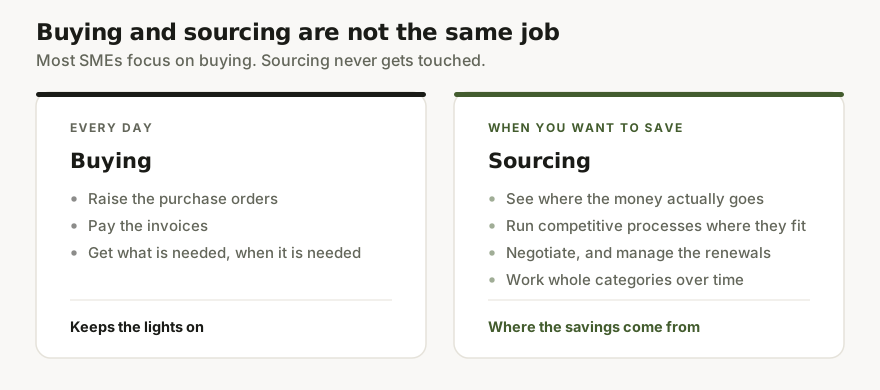
SMEs typically focus the most on buying - which keeps the lights on - whilst enterprises switch on sourcing - which enables them to find significant savings.
Because they buy in larger volumes, and volume alone buys better prices, every hour of sourcing effort returns more. They have an advantage they can exploit because of their size.
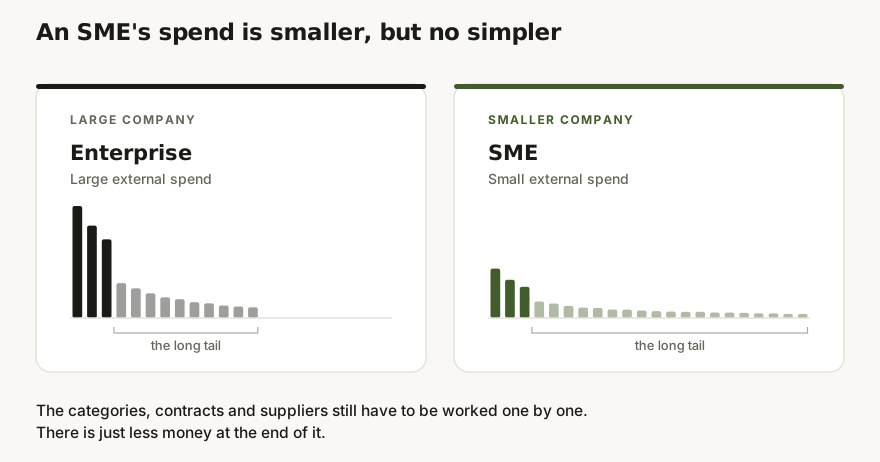
An SME's spend is smaller, but hardly simpler: typically a few large direct categories and a long tail of smaller ones, with almost enterprise-level complexity in categories, contracts and suppliers. Same level of work, with a smaller prize at the end.
The threshold between running a sourcing function and generating enough savings sat firmly in enterprise territory for decades. Running a sourcing function for an SME didn't make sense. It would cost more than it returned.
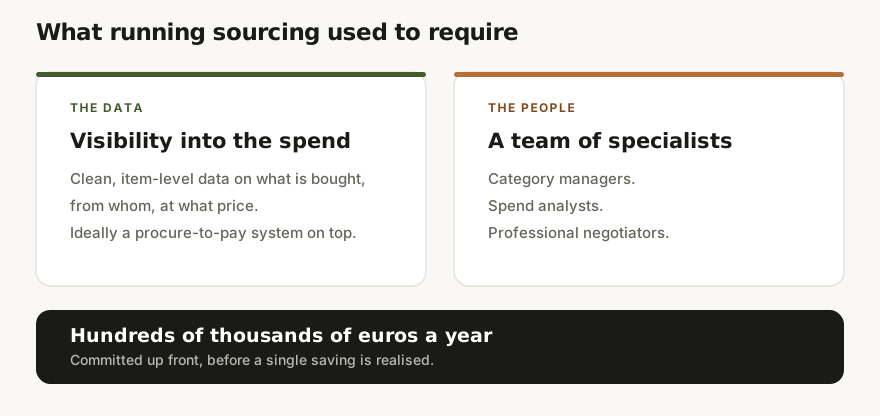
Enterprises have built procurement functions and captured the savings whilst SMEs ran operational buying. 60% of enterprises run procure-to-pay systems, whereas only 30% of mid-sized businesses do, even though these tools have the potential to take 2-5% out of the cost base.
For smaller businesses, these systems aren't affordable and they don't have anyone to run them. Margins can start to plateau 30-40% as a result.
Two things have changed: people are more productive, and tools are cheaper
The big one is in people productivity. McKinsey's benchmarking (2025) finds procurement teams now manage 50% more spend per person than they did five years ago, and projects the function becoming 25-40% more efficient as agentic AI takes over the routine work.
Humans are able to use agents to support classifying spend, chasing data, drafting tenders, reconciling invoices, monitoring contracts, and more. Human judgement will become more important on strategy, tactics and negotiation. We see this dynamic spreading across the market today.
What used to take the work of a large team can be done by individuals and small teams. Expertise has become accessible to SMEs at the right price point.
Secondly, the tools are getting cheaper. What used to cost six figures and take a year-long implementation now ships as AI features and agents at a fraction of the cost and time. You no longer buy a big platform and staff a team to operate it. You hire one expert to define a strategy, and point agents at your spend. They get to work on the long, boring manual work of reviewing data of small categories and one-off suppliers that no human team ever previously had the time to work on. Then the experts work with the business to make the right decisions.
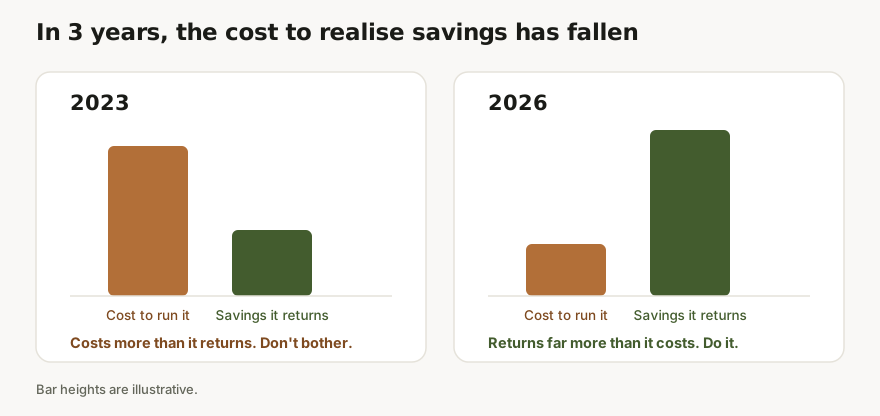
Put those two together and the cost to return threshold drops through the floor. We call this the Savings Threshold.
The Savings Threshold
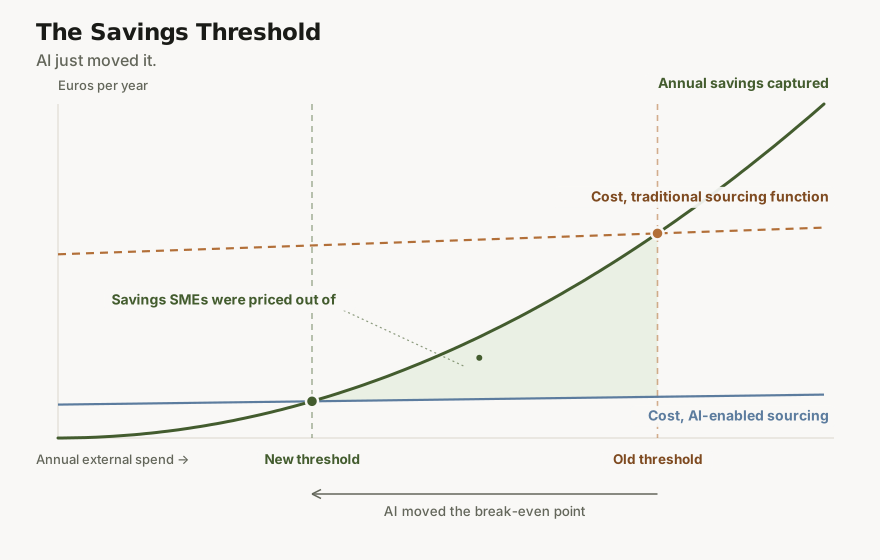
The Savings Threshold is the point where the cost of realising savings starts to make sense. Above the threshold, sourcing returns 2-3x the cost. Below it, you spend more time looking for the savings than you ever realise, which is where most SMEs used to get stuck.
The Threshold has now moved a long way. A company that was priced out of proper sourcing three years ago can now sit comfortably right inside it.
This has moved extremely fast. In 2023, McKinsey's own advice to SMEs was to build miniature versions of the enterprise machine: centres of excellence, planning teams, governance calls... nuts right!
Three years later, that world has completely changed. McKinsey might not understand this yet, but SME leaders need to. You have the opportunity to massively increase margins with small changes in procurement: hire an expert, give them the right tools and ownership.
We see this in our customer base: there are 4 SMEs currently running AI-enabled sourcing, and we're measuring 6%+ year-on-year savings.
Sure, a large enterprise will still do better than this because they have the volume and department budget to match. But there is a tangible opportunity now for SMEs that most aren't aware of.
What a €1M saving looks like vs. €3.3M of new sales
Take one of our customers for instance. They are a mid-sized manufacturer with a 30% gross margin. They target winning €3.3M of new business every year through sales, which adds around €1M of gross profit. They need to find, win, deliver and wait quarters to collect cash, all with a lot of uncertainty.
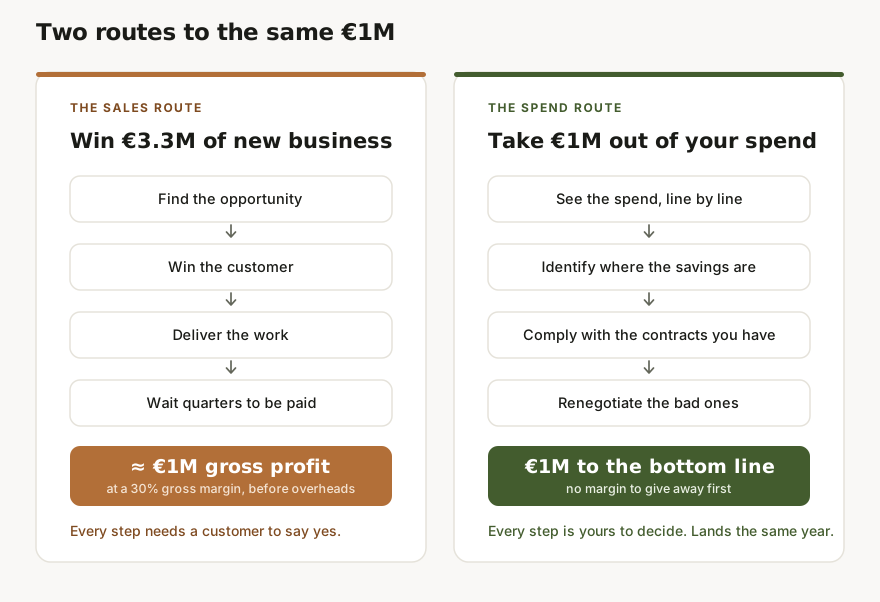
By focusing on optimising their external spend, they achieved the same result with much less effort and uncertainty. The procurement team became the heroes for once!
The €1M annual saving puts them far ahead of their competitors. They have a structural advantage. Same market, same suppliers, same input costs, different cost base with stronger margins.
SMEs like them now have a tangible opportunity to accelerate ahead of their competitors.
AI creates the conditions for savings, but someone still has to go and realise them
Sure, AI has had a large part to play in reducing the costs involved for SMEs. It creates the conditions for savings, but it won't achieve them itself. The decision has to be made, and the right people hired and given ownership.
Someone has to renegotiate the contracts, consolidate the suppliers, catch the auto-renewals before they roll, and change how people buy.
The main thing that holds everyone back is spend transparency. Being able to see what you spend unlocks everything else. This is what Groundley was built for.
Ultimately, capturing the value requires a change in the behaviour of the people in the business, and this is the biggest hurdle to overcome. AI can find the opportunity, draft the tender and flag the renewal date, but someone still has to make the call, have the awkward conversation, and change buying habits.
Capturing the value is a behavioural change programme wearing a technology costume.
Companies that treat it as a software purchase get a dashboard, whereas companies that treat it as a change in how they buy get the 6%+ saving on their spend.
Where to start
We're publishing our framework on Gold Standard Procurement for SMEs soon, so that you can self-assess where you are, what you're doing well and what needs to improve.
We're also running a series of webinars for SMEs to help them understand more. Both go out to the same list, so sign up here and you'll get the new pieces and the webinar invitations together.
You can also read the research this piece draws on in our evidence library, a curated set of 22 sources on procurement and the Nordic mid-market.
You can contact me anytime at mads@groundley.com if you have any questions, or insights to share.
Happy saving!
New pieces and webinar invitations, straight to your inbox.
One signup. You get the research summaries, guides like this one, and the invitations to our SME webinars.
Sign up →
Mads Zeidler
Ten years leading procurement for Scandinavia's largest companies at Prokura, now part of Kearney. Grew up around a family business, so he knows the mid-market from the inside.
Sources
- McKinsey (2017): Using a rapid procurement transformation to generate cash quickly
- McKinsey (2023): How medium-size enterprises can better manage sourcing
- McKinsey (2025): Transforming procurement functions for an AI-driven world
- MIT NANDA initiative (2025): The GenAI Divide: State of AI in Business 2025, as covered by Fortune
- APQC (2025): AI in Procurement: 10 Use Cases and 5 Key Benefits